The question matters more than the method: once an LLM is used to keep optimising an agent system itself, the optimisation loop needs regularising too. The paper picks apart the familiar pattern of gains that vanish on unseen tasks, and turns it into a set of constraints on how the search moves.
阅读结论Verdict问题真实 / 方法可借用 / 统计证据偏薄Real problem, reusable method, thin statistics
适合当作工程 checklist,不适合当作「某机制已被严格证明」的引用来源。
Treat it as an engineering checklist, not as proof that a mechanism works.
+6.0 / +1.1 / +4.9三个 evolve split 的绝对增益(分):Terminal-Bench 2.1、Harvey LAB、EngDesignAbsolute gain in points on the three evolve splits: Terminal-Bench 2.1, Harvey LAB, EngDesign
39.7 → 43.6三个 agentic 分布外 benchmark 的平均分,基线均值为 39.4Average over three agentic out-of-distribution benchmarks; the baseline average is 39.4
2.42M最终 harness 每 trial 的 policy token,是四个演化臂里最省的Policy tokens per trial for the final harness - the cheapest of the four evolved arms
论文Paper
RRSI: Regularized Recursive Self-Improvement of Agent Harnesses
Peng Xia 等 14 位作者,Google Cloud AI Research 与 UNC-Chapel Hill、Stanford、Washington University in St. Louis 合作。
Peng Xia and 13 co-authors, from Google Cloud AI Research with UNC-Chapel Hill, Stanford and Washington University in St. Louis.
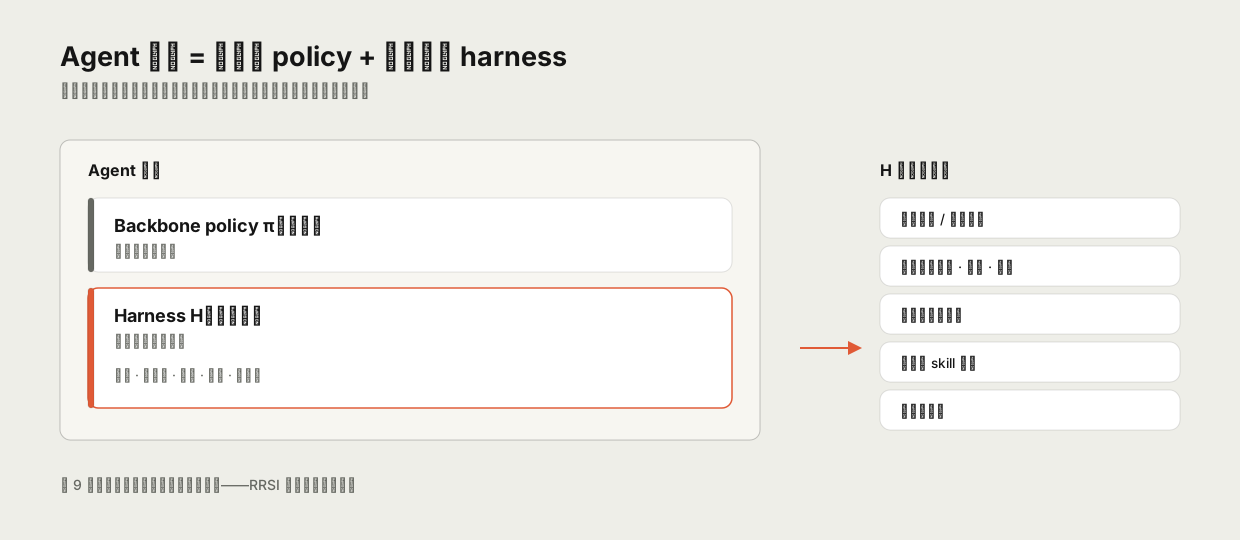
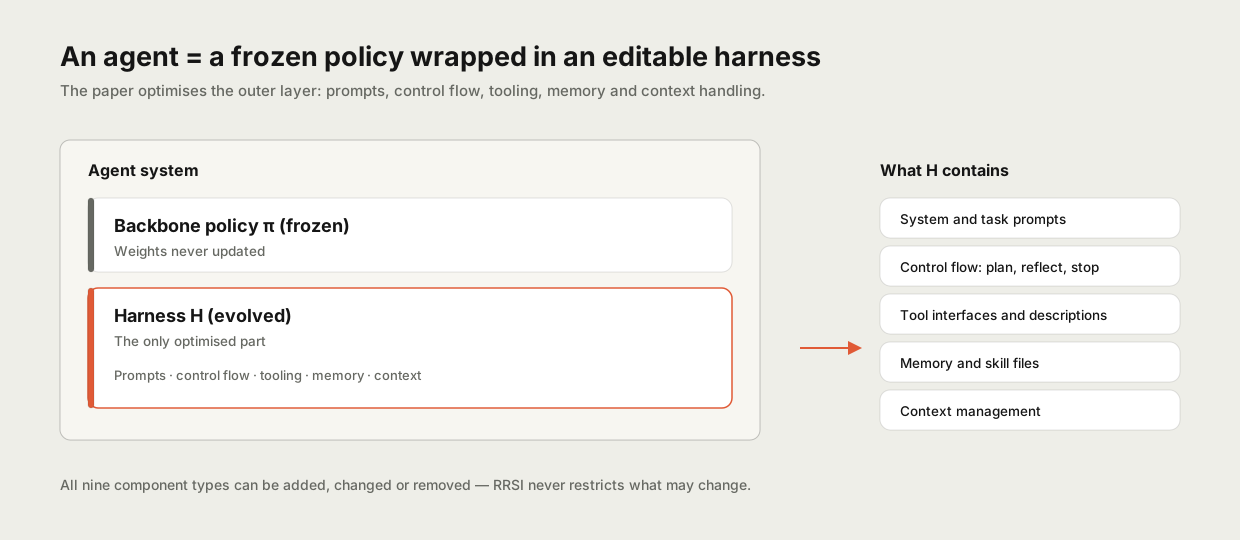
A modern LLM agent is a system, not a model. A frozen backbone policy is wrapped in a harness: system and task prompts, the control flow that decides when to plan, act, reflect or stop, tool interfaces and their descriptions, memory and skill files, and the context handling that decides what the policy sees at each step.
图 1 · 论文优化的是 harness 这一层。backbone 权重全程不变,被搜索的是提示、控制流、工具描述、记忆与上下文管理这些代码与配置。依据原文 p.1 Sec.1 与 p.3 Sec.2 重绘。Figure 1 - What the paper optimises is the harness layer. The backbone weights never change; the search covers prompts, control flow, tool descriptions, memory and context handling. Redrawn from p.1 Sec.1 and p.3 Sec.2.
The starting point is that much recent progress in agent products came from harness engineering rather than new model weights, and that this work has been manual: engineers read failed trajectories and tweak the scaffold by hand, so progress is bounded by how many trajectories a person can read. A family of methods now automates it, using an LLM proposer to rewrite the harness and keeping the edits that raise a benchmark score.
One clarification: what gets optimised is harness source code with frozen backbone weights, so this is self-improvement at the agent-system level, not at the weight level. The paper states this itself in Sections 2 and 3.
缺口:有限演化集上的自适应过拟合
Gap: adaptive overfitting on a finite evolve set
论文指出的缺口很具体,不是泛泛地说「效果不好」:演化过程会跨轮复用同一批任务。第 t 轮的候选集合由上一轮在同一批任务上的测量结果决定,因此后续候选的分布依赖此前的测量——这是一次典型的数据窥探。
The gap is specific rather than vague: the evolution loop reuses one task set across rounds. The candidates proposed in round t depend on measurements taken on that same set in earlier rounds, so later candidates are drawn from a distribution conditioned on earlier measurements - a textbook case of data snooping.
论文把由此产生的失败拆成三种耦合行为,每一种都对应后面的一条约束:
The paper splits the resulting failure into three coupled behaviours, each mapping onto a later constraint:
The search encodes patterns specific to the evolve set - sometimes task names, entities or answers - directly into the harness. It maps onto leakage screening and structural pruning.
02
追逐评测噪声
Chasing evaluation noise
候选因为随机波动而获胜,随后被固化成永久状态。对应约束是噪声调整接受下限与全历史信用分配。
Candidates win on random variation and are then frozen into permanent state. It maps onto the noise-adjusted floor and evidence-aware credit assignment.
03
复杂度累积
Complexity accumulation
harness 越堆越厚,演化分变高,但底层机制没有变好。对应约束是退火编辑预算与复杂度感知接受。
The harness thickens, the evolve score rises, and the underlying mechanism does not improve. It maps onto the annealed edit budget and complexity-aware acceptance.
The paper's own Figure 1(a) shows how general this is: all four recent evolution methods fall below the 1:1 transfer line. TTHE ends roughly 4.3% below its own starting point out of distribution, while AHE and HarnessX sit at about zero relative gain.
核心思想:正则化搜索过程,而不是限制编辑空间
Core idea: regularise the search, not the edit space
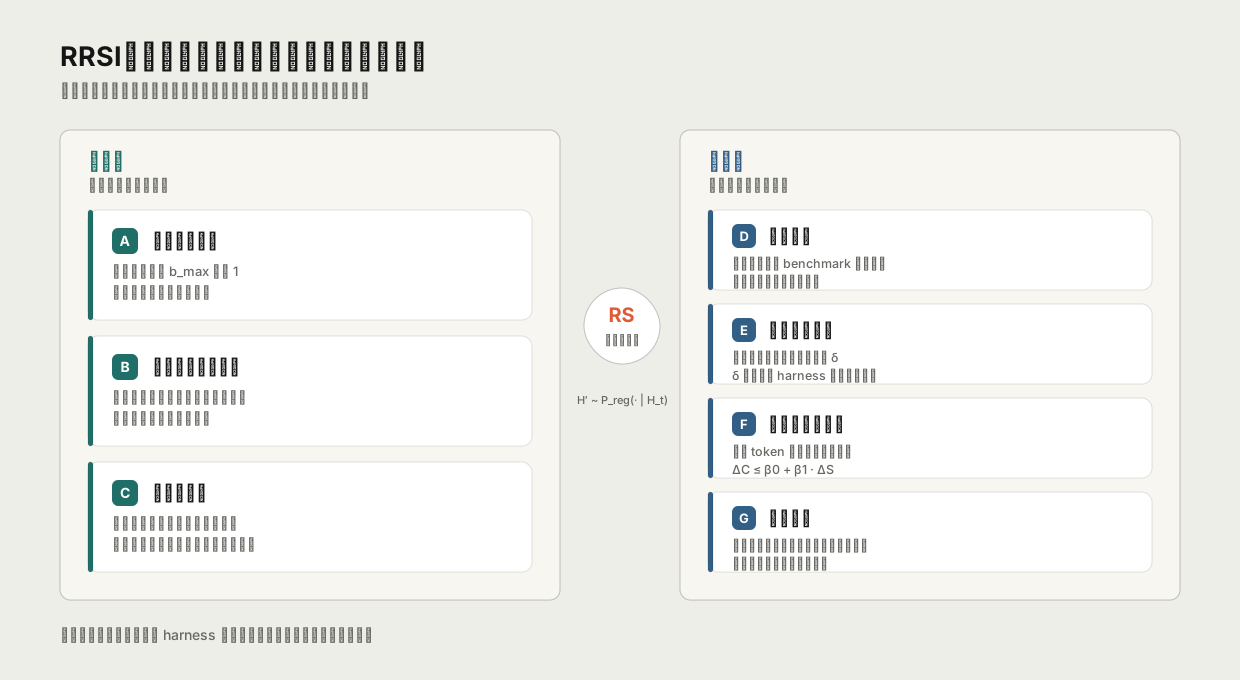
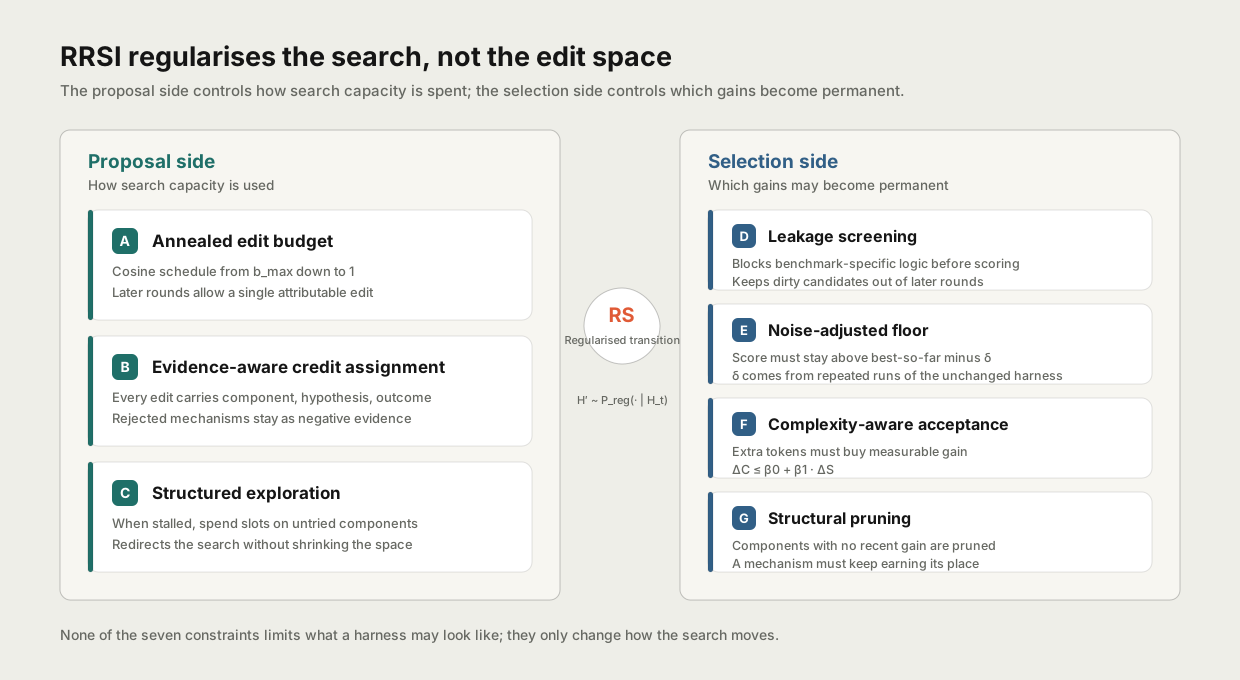
RRSI's judgement is that you should not prevent overfitting by shrinking what a harness may contain, but by constraining how the search moves. The edit space stays open: prompts, control flow, configuration, context handling, tooling, skills, memory and subagents can all be added, changed or removed - nine component types in total.
图 2 · RRSI 的结构:提案侧控制搜索容量怎么花,选择侧控制哪些增益可以变成永久状态。七条约束里没有一条限制 harness 能长什么样。依据原文 p.4 Fig.2、p.20 Alg.1-2 与 p.21-22 Eq.13-17 重绘。Figure 2 - How RRSI is arranged: the proposal side controls how search capacity is spent, the selection side controls which gains may become permanent. None of the seven constraints limits what a harness may look like. Redrawn from p.4 Fig.2, p.20 Alg.1-2 and p.21-22 Eq.13-17.
Three classical regularisation concepts are translated into search-process analogues: the edit budget as an L0-style cardinality constraint, structural pruning as Lasso/L1-style sparsification, and complexity-aware acceptance as Ridge/L2-style shrinkage. The authors stress three times, in the body and the appendix, that these are functional analogies rather than mathematical equivalences - the procedure optimises no norm-penalised objective, and heterogeneous harness components are not coordinates of a shared continuous parameter vector.
The practical consequence is direct: these are not coefficients you tune like a regularisation weight. Each rule is calibrated on its own terms - the noise band δ, for example, is measured by repeatedly evaluating the unchanged harness rather than derived from a loss function.
Caps how many independently attributable edits one candidate may bundle. The budget follows a cosine schedule from 4/3/4 (coding, workspace, engineering design) down to 1 in the final round: broad coordinated change early, single attributable edits late.
B · 证据感知信用分配
B - Evidence-aware credit assignment
每条原子编辑都记录组件、假设、源码 diff、分数与成本变化、是否被接受。被否掉的机制留作负证据,而不是重新再试一遍。这与 A 是耦合的:预算退火到 1 之后,候选级的测量才等价于单条编辑的效应。
Every atomic edit carries its component, hypothesis, source diff, measured score and cost change, and whether it was accepted. Rejected mechanisms stay as negative evidence instead of being retried. This couples to A: only once the budget anneals to one does a candidate-level measurement equal a single edit's effect.
When progress over three consecutive rounds stays inside the noise band, part of the proposal budget is reserved for component types never yet exercised. It redirects where the search looks without changing what may be edited.
Before full evaluation, a critic reads each candidate diff and rejects edits that encode task names, entities, answers or benchmark-specific logic, along with edits that only add inert machinery. Screening before scoring is the point: a leaking candidate never receives the inflated score that would let it contaminate later rounds.
Before evolution starts, the unchanged harness is evaluated repeatedly to estimate an empirical noise band δ. No candidate may then score below the best-so-far minus δ, which stops the search from walking downhill through a sequence of individually tiny regressions. The three domains use δ of 1.7, 0.4 and 2.0 points.
When the gain clears the noise band, the cost increase must satisfy ΔC ≤ β0 + β1 · ΔS: extra inference cost has to buy measurable improvement. β0 is the base allowance and β1 sets how much more cost a larger gain may justify. Inside the noise band a shaped rule applies instead, where lower cost or a structurally novel component is what earns admission.
Components that have been exercised but produced no strictly positive gain in the recent window become deletion targets for later proposals. Score-only search has no incentive to remove anything; pruning supplies it, so a mechanism has to keep earning its place.
一轮演化里的准入决策链
The admission chain inside one round
01
提案:受约束的候选
Proposal: a constrained candidate
候选来自受 A、B、C 约束的提案分布,编辑条数不超过当前预算,且携带组件与假设元数据。
The candidate comes from a proposal distribution constrained by A, B and C, bundles no more than the current budget, and carries component and hypothesis metadata.
02
筛查:评测之前的泄漏检查
Screening: leakage check before scoring
命中 benchmark 专属逻辑的候选直接丢弃,不消耗评测预算,也不会把虚高分数写进历史。
Candidates carrying benchmark-specific logic are dropped without spending evaluation budget and without writing an inflated score into the history.
03
下限:不得跌破噪声带
Floor: stay inside the noise band
评测后先看分数是否仍在历史最好值减 δ 之上,不通过就直接丢弃。
After evaluation, the score must still sit above best-so-far minus δ; failing that, the candidate is discarded.
A gain beyond the noise band goes through the cost rule; a gain inside the band goes through the shaped rule and must earn admission from lower cost or structural novelty. The coding domain sets the score weight to zero, so a within-band score increase counts for nothing by itself.
05
合并:非补偿性选择
Merge: non-compensatory selection
所有条件取 AND 而不是加权求和:域守卫、下限和成本条件必须同时通过,候选才进入可接受集合,再由分数选出胜者;如果一个都没有通过,就保留当前 harness。
Conditions are combined with AND rather than a weighted sum: domain guards, the floor and the cost condition must all pass before a candidate joins the admissible set, and the highest score wins. If nothing passes, the incumbent harness is kept.
实验设置:三域八个 benchmark
Setup: three domains, eight benchmarks
每个域只在一个 suite 上演化,然后原样迁移到其余 benchmark。这种 evolve / 同分布留出 / 分布外三层分离,是这篇论文证据链里最值得借用的部分。
Each domain evolves on exactly one suite and is then run unchanged on the others. This three-way split between evolve, in-distribution hold-out and out-of-distribution is the most reusable part of the paper's evaluation design.
Benchmark
域 / 角色
Domain / role
规模
Size
判分方式
Scoring
Terminal-Bench 2.1
编码 / evolve
Coding / evolve
89 个任务
89 tasks
容器内真实 shell,自带隐藏单测(确定性)
Real shell in a container, hidden unit tests (deterministic)
SWE-bench Verified
编码 / 分布外
Coding / OOD
真实 GitHub issue
Real GitHub issues
fail-to-pass 与 pass-to-pass 测试(确定性)
fail-to-pass and pass-to-pass tests (deterministic)
Harvey LAB
工作台 / evolve 与同分布留出
Workspace / evolve and ID hold-out
120 + 40 个任务
120 + 40 tasks
每任务 20 至 100 条判据,整轮约 14,000 条(LLM 评委)
20 to 100 criteria per task, about 14,000 per run (LLM judge)
JobBench
工作台 / 分布外
Workspace / OOD
真实职业工作流
Real professional workflows
加权 rubric,两个模型取平均
Weighted rubric, averaged over two models
GDPval
工作台 / 分布外
Workspace / OOD
185 个任务
185 tasks
与人类专家交付物并排比较,三位评委多数投票
Side-by-side against human expert work, majority of three judges
APEX-Agents
工作台 / 分布外
Workspace / OOD
480 个任务
480 tasks
沙盒 MCP 工具面加 rubric(LLM 评委)
Sandboxed MCP tool surface plus rubric (LLM judge)
EngDesign
工程设计 / evolve
Eng. design / evolve
61 个任务
61 tasks
每任务自带冻结模拟器(确定性)
Each task ships a frozen simulator (deterministic)
Frontier-Eng
工程设计 / 分布外
Eng. design / OOD
47 个任务,38 个计入
47 tasks, 38 counted
冻结评测器,报 Medal Score(确定性)
Frozen evaluator, reported as Medal Score (deterministic)
In all three domains the policy, proposer, failure analyst and leakage critic are Claude Opus 4.8. Evolution runs for 20 / 20 / 40 rounds with 2 / 2 / 4 trials per task per evaluation. The paper states that all hyperparameters were chosen using only the evolve environment and engineering considerations, never the held-out or out-of-distribution benchmarks.
Three fairness measures are worth noting separately: a harness and its baselines are always evaluated in the same window; containers are torn down and rebuilt between arms so no state carries over; and infra failures in APEX-Agents count as failures rather than being excluded, so a harness that crashes on hard worlds does not look better for it.
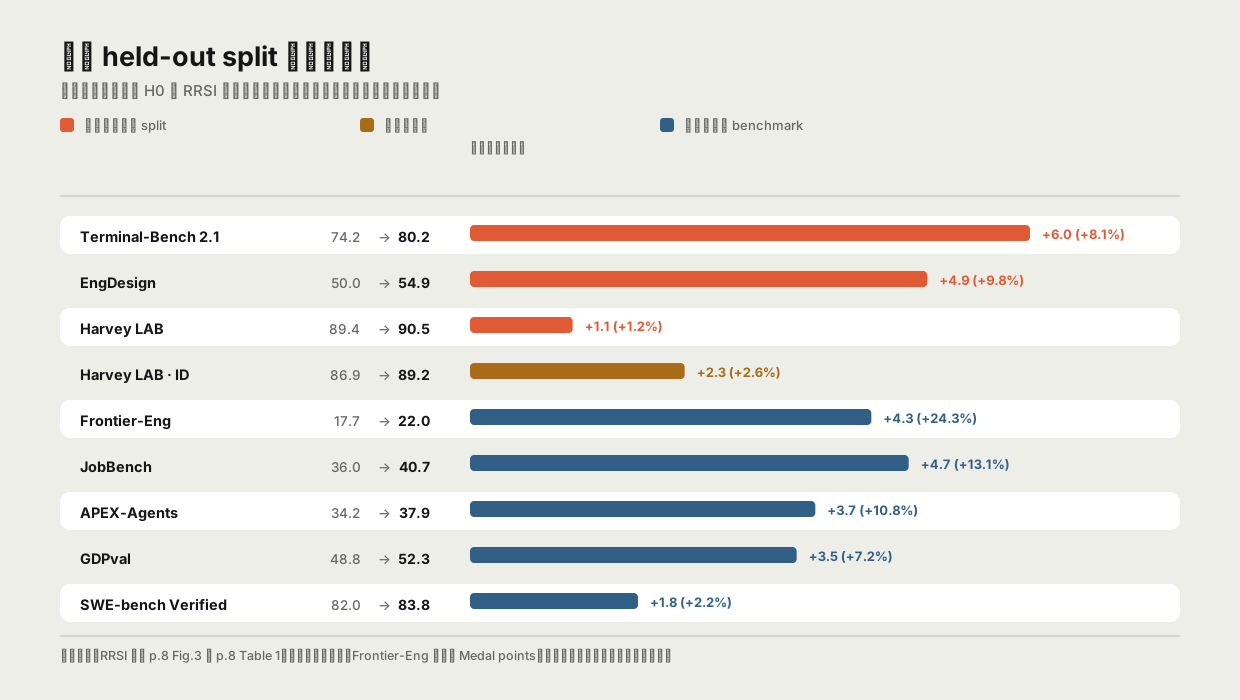
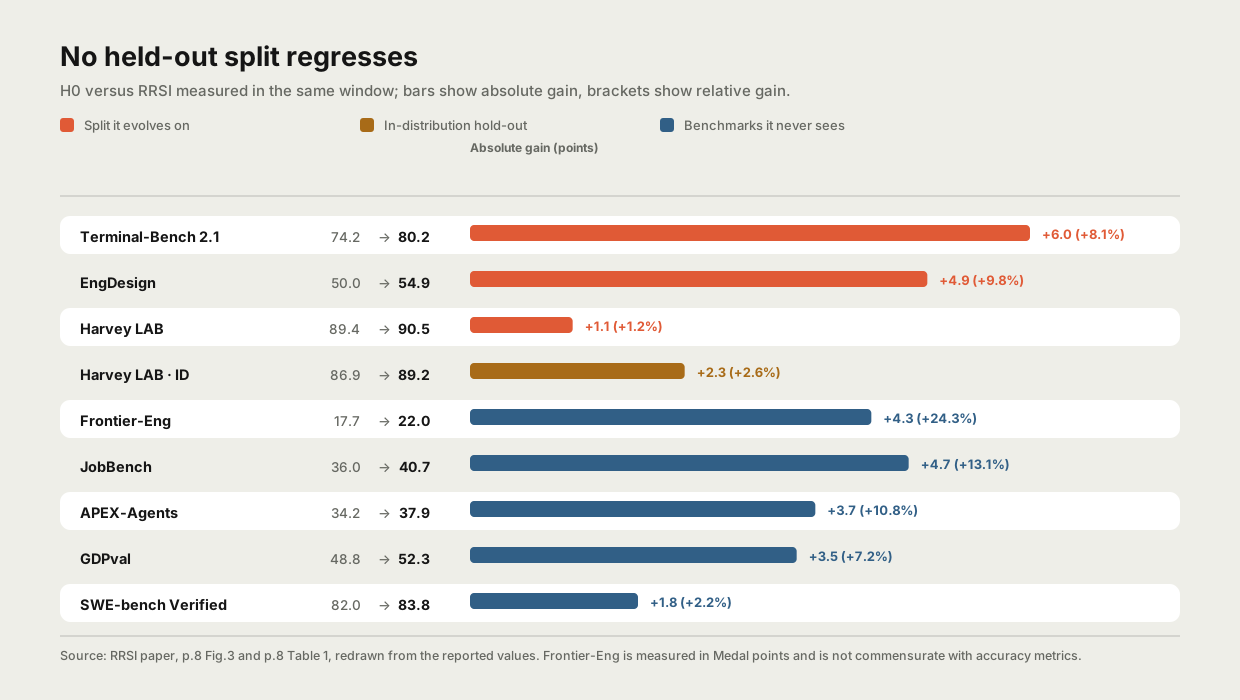
Every number is compared against the unevolved harness measured in the same window, so the gains cannot be attributed to drift in the evaluation infrastructure. The evolve-set gains are 6.0, 4.9 and 1.1 points; what matters is what survives once the harness leaves those suites.
图 3 · 每个 held-out split 都没有回退。SWE-bench 的 +1.8 与编码域噪声带 1.7 几乎同量级,是整篇论文里最需要保留态度的那个数字。数据来源:原文 p.8 Fig.3 与 p.8 Table 1,按原数值重绘。Figure 3 - No held-out split regresses. SWE-bench's +1.8 sits almost at the coding noise band of 1.7, making it the number most in need of caution. Source: p.8 Fig.3 and p.8 Table 1, redrawn from the reported values.
Benchmark
角色
Role
未演化
Unevolved
RRSI
绝对增益
Absolute
相对增益
Relative
Terminal-Bench 2.1
演化集
Evolve
74.2
80.2
+6.0
+8.1%
EngDesign
演化集
Evolve
50.0
54.9
+4.9
+9.8%
Harvey LAB
演化集
Evolve
89.4
90.5
+1.1
+1.2%
Harvey LAB
同分布留出
ID hold-out
86.9
89.2
+2.3
+2.6%
SWE-bench Verified
分布外
OOD
82.0
83.8
+1.8
+2.2%
JobBench
分布外
OOD
36.0
40.7
+4.7
+13.1%
GDPval
分布外
OOD
48.8
52.3
+3.5
+7.2%
APEX-Agents
分布外
OOD
34.2
37.9
+3.7
+10.8%
Frontier-Eng
分布外(Medal)
OOD (Medal)
17.7
22.0
+4.3
+24.3%
两个细节值得留意。第一,Frontier-Eng 的单位是 Medal points,与其余准确率类指标不可直接相加。第二,Harvey LAB 的同分布留出上,RRSI 与最强基线 Meta-Harness 打成平手,分离只出现在分布外。
Two details matter. First, Frontier-Eng is measured in Medal points and is not commensurate with the accuracy metrics. Second, on the Harvey LAB in-distribution hold-out RRSI ties the strongest baseline, Meta-Harness; the separation only appears out of distribution.
Four recent evolution methods start from the same harness as RRSI and share the frozen policy, evolve set and candidate budget. The result: the baselines are stronger on the evolve split, and are overtaken out of distribution.
The most counter-intuitive row is this: RRSI posts the smallest evolve-set gain of any evolved method (+1.1) and trails all four baselines there. What it buys is the only out-of-distribution average that clears the baseline mean by more than four points (43.6 against 39.4).
Another fact worth recording: after evolution, TTHE and AHE score below their own starting point out of distribution (38.0 and 39.2 against 39.7). Doing harness evolution is not the same as improving a harness.
A caveat worth keeping: the paper says the four baselines share the same harness, policy, evolve set and candidate budget, but does not say whether it used each method's official code or a reimplementation. For methods this sensitive to scaffold and prompts, a reimplementation gap of one to two points is easy. Treat claims like "TTHE ends below its starting point" with care.
The ablation runs only in the workspace domain with everything else held equal. Removing either side of the regularisers raises the evolve score and lowers transfer; removing both gives the highest evolve score while leaving the out-of-distribution average at 40.3, under a point above the starting point, at 1.57 times the token cost.
Three robustness experiments show the gains are not an artefact of one policy. Two policy families evolve independently and transfer in the same direction in the coding domain, and a harness evolved with Gemini 3.5 Flash is handed unchanged to Gemini 3.1 Flash Lite, which never took part in the search, lifting Terminal-Bench from 11.2 to 14.6.
评测 policy
Evaluation policy
Terminal-Bench 2.1(演化集)
Terminal-Bench 2.1 (evolve)
SWE-bench(分布外)
SWE-bench (OOD)
Claude Opus 4.8
74.2 → 80.2
82.0 → 83.8
Gemini 3.5 Flash
64.6 → 78.7
76.8 → 79.0
Gemini 3.1 Flash Lite(未参与搜索)
Gemini 3.1 Flash Lite (unseen)
11.2 → 14.6
—
成本:省的是相对值,不是绝对值
Cost: cheaper than the alternative, not than nothing
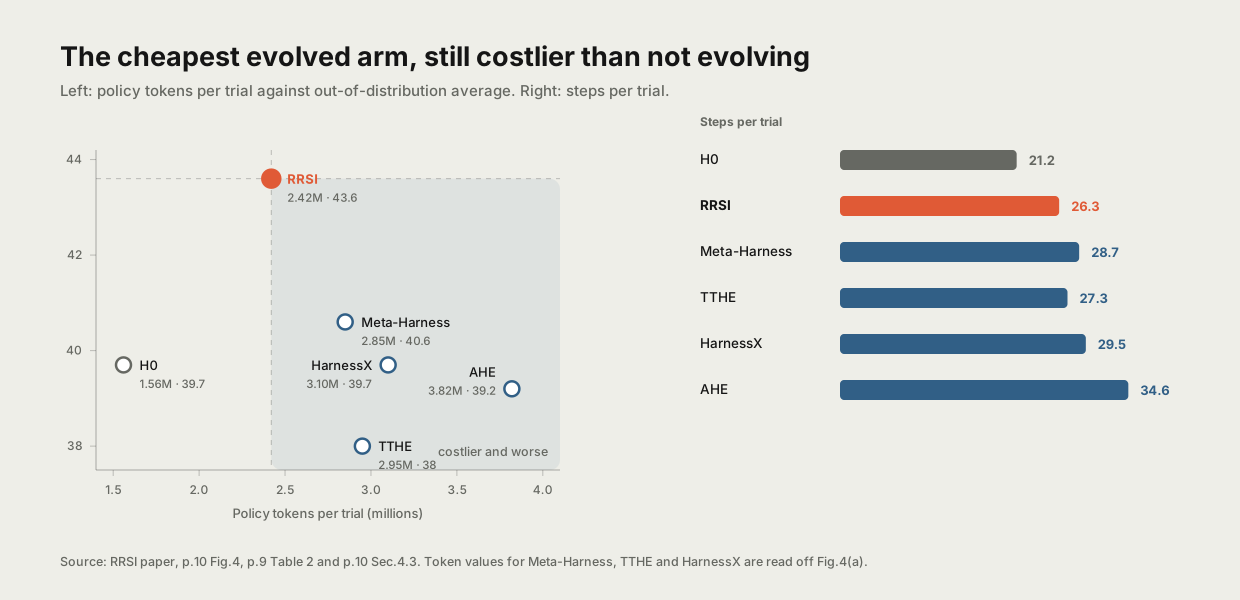
The abstract's claim of running on 30% fewer policy tokens than unregularised evolution is easy to misread. The comparison is against unregularised evolution (3.80M), not against not evolving at all, and the figures in Table 2 actually give −36.3%, not 30%.
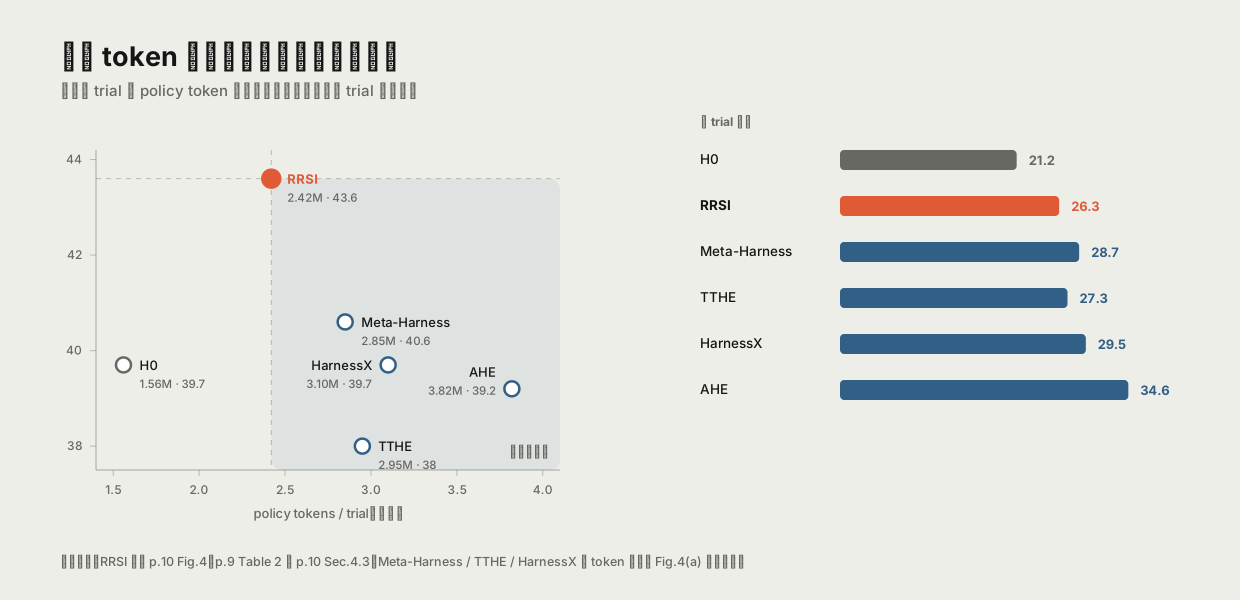
图 4 · RRSI 是四个演化臂里最便宜的,但相对未演化的起点其实是多花 55% 的 token(1.56M 到 2.42M)。论文正文诚实地写了「没有哪个演化后的 harness 像起点一样便宜」,只是摘要的表述容易被误读。数据来源:原文 p.10 Fig.4、p.9 Table 2 与 p.10 Sec.4.3。Figure 4 - RRSI is the cheapest of the four evolved arms, yet it spends 55% more tokens than the unevolved starting point (1.56M to 2.42M). The body text is candid that no evolved harness is as cheap as the starting point; the abstract wording is where the misreading creeps in. Source: p.10 Fig.4, p.9 Table 2 and p.10 Sec.4.3.
One cost is missing entirely: the evolution process itself. Twenty to forty rounds, several candidates per round, two to four trials per candidate per evaluation, plus proposer and critic calls - and the number of candidates per round is never given a value in the paper. Anyone adopting this should estimate that bill first.
批判性评估
Critical assessment
强证据Strong evidence三域八个 benchmark 的跨域迁移设计,且每个数字都与同一窗口内的未演化起点对比;工程设计域由冻结模拟器确定性判分,为「增益不是迎合评委」提供了不受 LLM judge 影响的独立证据;消融的三条曲线方向一致(去掉正则即演化分涨、迁移跌、成本涨);两个 policy 家族加一个更弱 backbone 的迁移,说明收益不绑定单一 policy。A cross-domain transfer design over three domains and eight benchmarks, with every number compared against the unevolved starting point in the same window. The engineering-design domain is scored deterministically by frozen simulators, giving independent evidence that the gains are not judge-flattery. The ablation moves consistently in three directions at once, and two policy families plus a weaker backbone show the gains are not tied to one policy.
中等或弱证据Weaker evidence所有主结果都是单点数值,没有随机种子、方差或置信区间;SWE-bench 的 +1.8 与编码域噪声带 1.7 几乎同量级;消融只做了「提议侧 / 接受侧」的分组,七个具体机制没有逐一隔离,而且只在一个域上做;泄漏筛查的筛除率与误杀率完全没有量化,也缺少人工审计;每轮候选数没有公布,演化总开销无法复算。Every main result is a single number with no seeds, variance or confidence intervals. SWE-bench's +1.8 sits almost at the coding noise band of 1.7. The ablation groups the regularisers into proposal and acceptance sides, isolates none of the seven mechanisms individually, and runs in only one domain. The leakage critic's rejection and false-positive rates are never quantified and no human audit is reported, and with no candidate count per round the total search cost cannot be recomputed.
结论是否超出证据Does the claim exceed the evidence核心结论没有超出证据,但有两处口径需要打折扣。一是摘要把「up to 14.1 points」放在最显眼的位置,而它来自较弱 policy 的那组实验,主实验同项只有 6.0。二是「省 30% token」与 Table 2 算出的 36.3% 不一致,也容易被误读成比不演化还省。此外,原文 Fig.2 里复杂度接受与结构剪枝的 L1、L0 角标相对正文是互换的,属于排版层面的错误,不影响方法理解。The core claim stays inside the evidence, but two framings deserve a discount. The abstract leads with "up to 14.1 points", which comes from the weaker-policy experiment, while the main experiment gains 6.0 on the same measure. And the 30% token saving disagrees with the 36.3% that Table 2 implies, while also inviting the misreading that it is cheaper than not evolving. Separately, Figure 2 in the paper swaps the L1 and L0 labels on complexity acceptance and structural pruning relative to the body text - a typesetting error that does not affect understanding.
可以带走的做法
What transfers
先用未改动的基线标定噪声带
Calibrate a noise band from the unchanged baseline
Before any automated optimisation starts, run the current system several times under the same evaluation protocol to get an empirical noise band, then refuse any candidate that falls below best-so-far minus that band. It is the cheapest way to stop a chain of small regressions from walking the system downhill, and it needs no confidence-interval machinery.
Allow several coordinated edits early to explore new mechanisms, then converge on a single attributable edit later. A cosine schedule is enough and costs almost nothing to implement, and it is the precondition that makes credit assignment meaningful.
Turn "make it prove it is better before you let it get bigger" into an executable admission rule. That needs a cost proxy - tokens, latency or tool calls all work - and choosing the proxy is itself an assumption worth stating out loud.
Filter after scoring and the dirty candidate has already written an inflated number into the history that later rounds will condition on. Screening before evaluation costs a few model calls and keeps the whole history clean.
Under a weighted sum, one strength can compensate for a serious weakness, such as saved tokens offsetting a performance collapse. Table 6 in the paper shows a correctly rejected case: a candidate saving 13.6% cost but losing 2.81 points was stopped by the floor.
用确定性判分交叉验证评委打分
Cross-check judged scores with deterministic grading
This is the paper's most reusable design move: if part of the evaluation depends on model judges, find another domain scored deterministically by frozen simulators and check whether the gains survive. It answers the "did it just learn to please the judge" objection directly.
What does not carry over: the specific values of δ, β0 and β1 are tied to the benchmark's units, trial count and task count, and must be recalibrated on your own system. The paper uses policy tokens as the sole proxy for complexity; if your bottleneck is latency or memory, you need a different proxy and a redesigned acceptance rule. The nine-type component taxonomy also has to be rebuilt for your own framework.
最小验证实验
Minimum validation experiments
如果要在自己的系统上验证这套方法,下面几个实验的性价比最高,按成本从低到高排列。
If you want to validate this on your own system, these experiments give the most information per unit of effort, ordered from cheapest to most expensive.
RRSI is built from six mechanisms that are individually familiar: annealing, entropy-style exploration, static screening, an early-stopping floor, an L2-style cost penalty and pruning. The contribution is not any single mechanism but the way they are arranged into one discipline - capacity allocation on the proposal side, state commitment on the acceptance side - with executable pseudocode and a hyperparameter table.
一句话:把这篇论文当工程 checklist 用,而不是当「某机制已被严格证明」的引用来源。最值得带走的是先标定噪声带、让编辑预算退火、每增加成本必须换回可测收益这三条。In one line: use this paper as an engineering checklist rather than as proof that a mechanism works. The three things worth taking are calibrating a noise band first, annealing the edit budget, and making every extra cost buy measurable gain.