The paper does something unusually practical: it treats a decision-only judge as a cheap first pass, measures it against 16 other judge configurations over 1,312 items, and reports where it is enough and where escalation is required — then shows that confidence itself can drive that gate.
阅读结论Verdict方法论可直接搬 / 级联数字别当承诺Reusable method, cautious cascade numbers
评测协议与阈值纪律值得照抄;费用与级联收益是离线模拟,落地前要自己复测。
Copy the protocol and the threshold discipline; re-measure the cost and cascade claims before relying on them.
0.36%JEV 的费用相对最强对照判官 GPT-6 的比例,同时差距在 3 个百分点以内JEV's fee relative to the strongest comparator, GPT-6, while staying within three points
−14.6 / −19.8JudgeBench(多步推导)与 RM-Bench 硬对(错误的答案写得更漂亮)上的差距,单位是百分点Gap in points on JudgeBench (multi-step derivation) and on RM-Bench hard pairs (a better-written wrong answer)
99.6% / 47%单序级联在 τ=0.9 时保留的准确率与所花费用(作为离线模拟的参考值)Accuracy retained and fee spent by the single-order cascade at τ=0.9, as an offline simulation
论文Paper
JEV-as-a-Judge: Accept When Confident, Escalate When Unsure
一个托管服务:输入自然语言指令与结构化状态,输出类型化概率(Choice / Noul / Score),不返回任何文字。实现闭源。
A hosted service that takes natural-language instructions and structured state and returns typed probabilities (Choice, Noul, Score). It never returns prose, and the implementation is proprietary.
LLM judges have moved from scoring fixed answers to judging open-ended behaviour, which brings two pressures. Reasoning judges bill by tokens, so the judge's fee becomes part of the cost of developing and operating the system. And models asked to report their own confidence are often overconfident, assigning high probabilities to wrong answers.
So the question splits into three parts that must be answered together: is the judge accurate, is its confidence usable, and how much cheaper is it really. As the paper puts it, a usable verdict, a correct decision and reliable uncertainty are three different things.
评测协议:怎么把这件事测公平
Protocol: how it is measured fairly
这部分是全文最值得借鉴的地方,也是最容易被忽略的:作者先冻结数据,再开始推理。
This is the most reusable and most easily skipped part: the data was frozen before any inference happened.
The 642-item pilot was frozen before any inference and split 40/60 by source question into a selection set and a test set; the 670-item extension was frozen before pilot accuracy was inspected and never entered a fit.
标签不改
Labels kept as supplied
benchmark 标签一律原样使用;人工修正后的准确率只作为敏感性分析单独报告,不进主结果。
Benchmark labels are used as supplied; human-corrected accuracies appear only as a sensitivity analysis, never in the primary results.
Every output is validated for schema, label membership, finite and normalised probabilities (tolerance 0.025) and verdict–argmax consistency. Invalid outcomes count as errors; nothing is repaired or rerun. Probability metrics condition on validity but keep the denominators.
配对差异用簇自助法
Cluster bootstrap for paired differences
2000 次按来源题目聚类的重采样,把同一问题的两条答案、以及一对样本的所有呈现变体绑在一起。
2,000 source-question cluster resamples keep the two answers to one question, and every presentation variant of a pair, together.
Bulk-run timings are not used for latency claims because client-side accounting caused contention; latency comes from a frozen 120-decision panel, one model group at a time, eight workers, 0.12-second minimum start interval.
The initial window evaluated JEV, three GPT baselines and PairRM; the expansion reran after those results were known, so the multi-family comparison is explicitly exploratory.
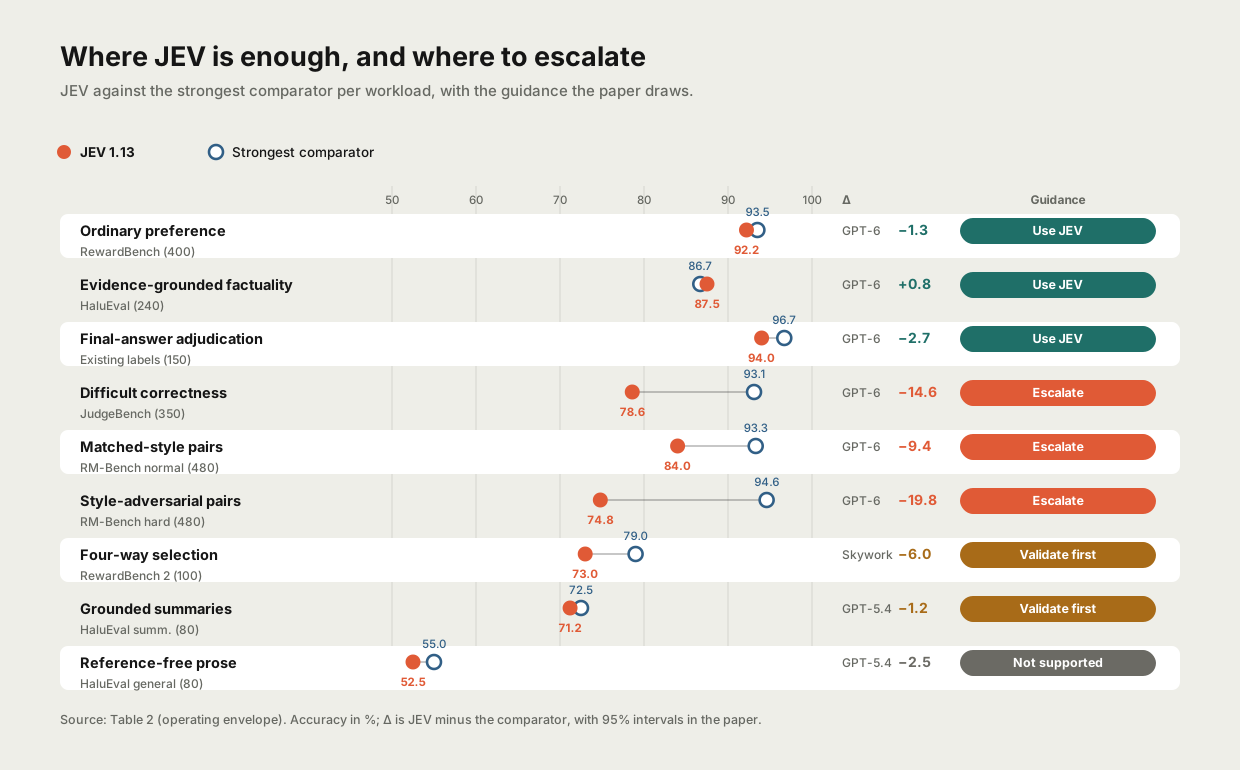
The same judge gets opposite verdicts depending on the workload. The line is clear: it holds up when the item ships with a reference answer or an evidence passage, and it does not when the judgment requires checking a multi-step derivation or resisting a better-written wrong answer.
图 1 · 适用边界。绿色是可以直接用,橙色是差距 9–20 个百分点、需要升级,黄色是必须先本地验证,灰色是所有被测判官都接近随机的区域。数据来源:原文 Table 2,按原数值重绘。Figure 1 - The operating envelope. Green means use it directly, orange means a 9–20 point gap and escalation, amber means validate locally first, grey is where every tested judge is near chance. Source: Table 2, redrawn from the reported values.
The difficult-correctness gap has structure: reasoning 68.4 against 95.9 (n=98), coding 76.2 against 97.6 (n=42), knowledge 84.4 against 90.9 (n=154). It concentrates in reasoning and code, which is exactly the "is this derivation right" kind of question.
One easily missed detail: blinded human adjudication favours GPT-6 more than the labels do. On RewardBench disagreements the adjudicator sided with GPT-6 17 times and JEV 5 times, widening the gap from −1.3 to −3.0; and 24 of the 26 HaluEval items both judges missed carry labels the evidence does not support, which corrects to JEV 95.8 and GPT-6 98.3. The "within three points" summary survives both label sets, while part of the HaluEval tie is label noise near the ceiling.
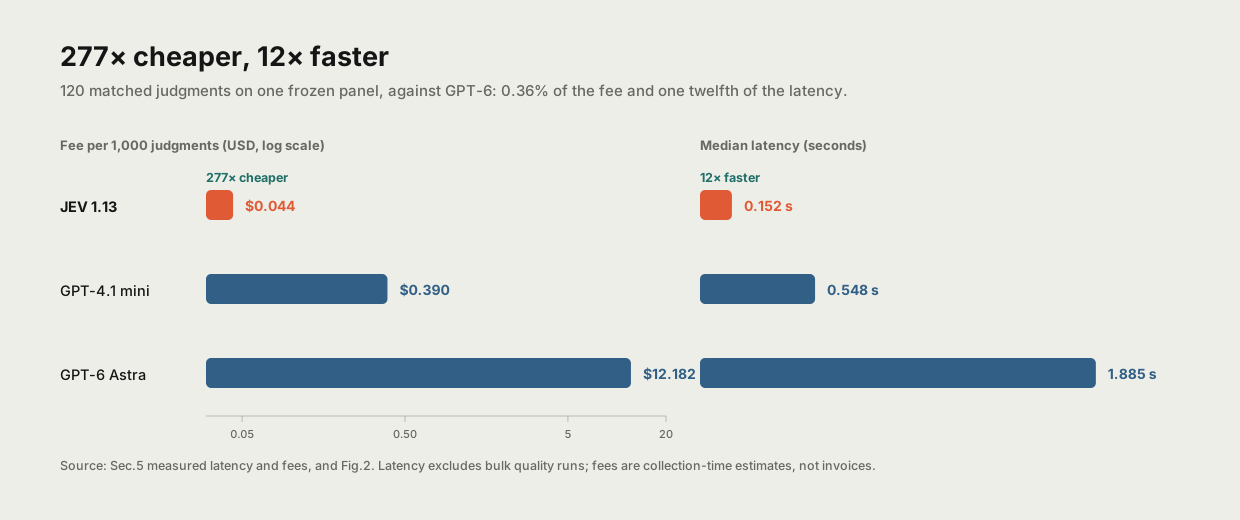
Fee and latency come from one frozen 120-decision panel, one model group at a time. The result is an order-of-magnitude difference rather than a few percent.
图 2 · 每千次判定 0.044 美元、中位延迟 0.152 秒。对照 GPT-4.1 mini 是 0.390 美元 / 0.548 秒,GPT-6 是 12.182 美元 / 1.885 秒。数据来源:原文 Sec.5「Measured latency and fees」与 Fig.2。Figure 2 - $0.044 per 1,000 judgments at a median 0.152 seconds. GPT-4.1 mini is $0.390 / 0.548 s and GPT-6 is $12.182 / 1.885 s. Source: Sec.5 measured latency and fees, and Fig.2.
Read the fee basis carefully: collection-time prices (JEV 1.13.0 at $0.042 per million input tokens, output free), including cache discounts and billed reasoning tokens; missing usage is charged as a conservative reservation rather than zero. Every dollar figure is an estimate, not an invoice.
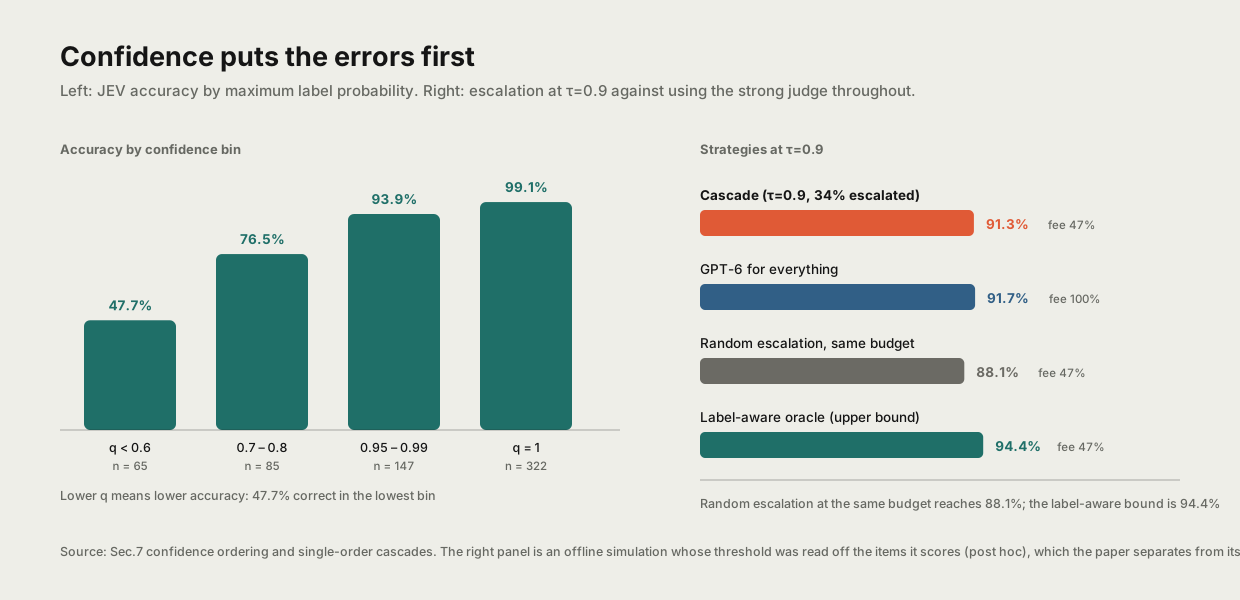
The cascade works because JEV is unsure where it is wrong. Accuracy rises monotonically with the maximum label probability q: 47.7% correct in the 65 items below 0.6, 93.9% in the 147 items between 0.95 and 0.99, and 99.1% of the 322 items at exactly 1. On the same items GPT-6 only moves from 78.5% to 99.1%, so its advantage sits exactly where JEV is unsure.
图 3 · 置信度把错误排在前面。左侧是论文按 q 分箱的准确率;右侧是 τ=0.9 的策略对比,升级 34% 的条目即可保留 GPT-6 准确率的 99.6%,花 47% 的费用。数据来源:原文 Sec.7「Confidence orders the errors」与「Single-order cascades」,右侧为离线模拟。Figure 3 - Confidence puts the errors first. Left: accuracy by q bin. Right: at τ=0.9, escalating 34% of items keeps 99.6% of GPT-6's accuracy at 47% of the fee. Source: Sec.7 confidence ordering and single-order cascades; the right panel is an offline simulation.
A key control: escalating the same 34% at random reaches only 88.1%, while escalating only the items that are genuinely wrong (the label-aware oracle bound) reaches 94.4%. Confidence captures about half of the attainable gain — real information, but far from all of it.
Because candidate order changes verdicts (reversal flips 3.25% of RewardBench decisions and 11.14% of JudgeBench decisions), the policy judges each pair in both orders and averages the aligned probabilities:
The threshold was chosen on 96 pilot selection pairs to maximise coverage while keeping selection-set accuracy within two points of the fallback; the grid and rule were fixed before the model expansion, and invalid first-stage outputs always defer.
Note the third row: with GPT-5.6 at τ=0.7 the policy accepts 81% of pairs but loses 2.35 points, beyond its own two-point tolerance — the threshold is not portable, and each fallback needs its own. The GPT-5.4 row also shows a conservative fee ratio of 1.096, above one, because missing usage is charged as a reservation.
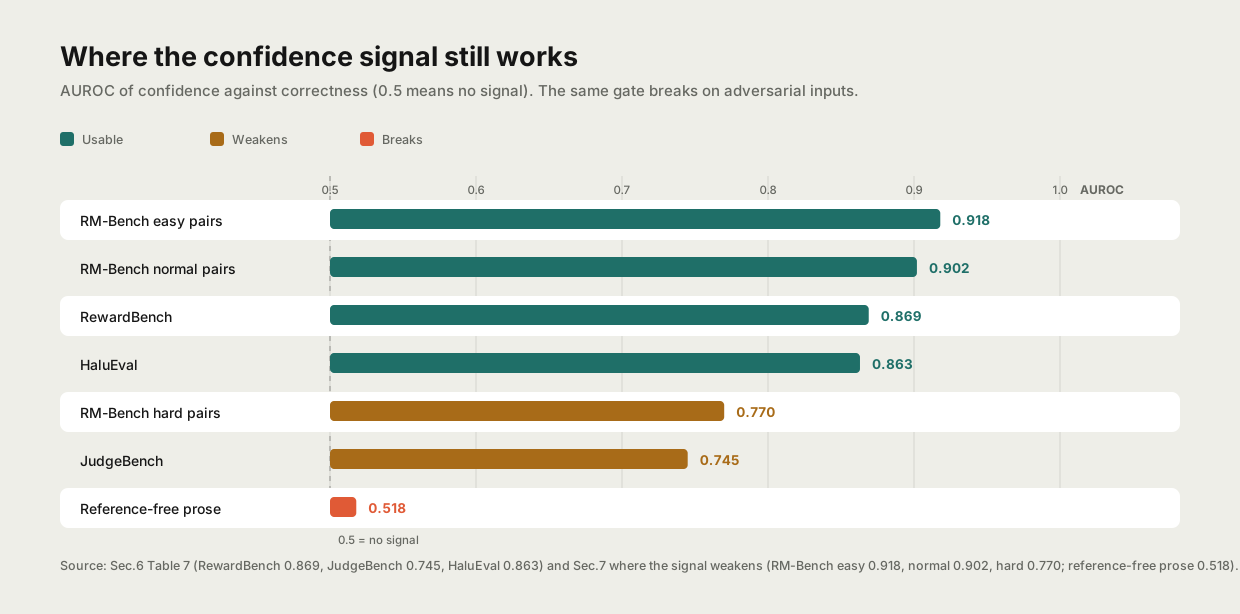
Gating on confidence assumes it can separate right from wrong. Measured as AUROC, the boundary appears: confidence routes well where the first stage is competent but uncertain, and badly where it is confidently misled.
图 4 · 置信度的可用性随 workload 崩塌。文风对抗的硬对上 AUROC 从 0.902 降到 0.770,无参考散文只有 0.518——那时所有判官都接近随机,却依然给出 0.90 以上的平均最大概率。数据来源:原文 Sec.6 Table 7 与 Sec.7。Figure 4 - Usable confidence collapses by workload. On style-adversarial hard pairs the AUROC drops from 0.902 to 0.770, and reference-free prose sits at 0.518 — where every judge is near chance yet still reports mean maximum probabilities above 0.90. Source: Sec.6 Table 7 and Sec.7.
文风对抗:写得更漂亮的错误答案
Style-adversarial: the better-written wrong answer
On RM-Bench hard pairs JEV is wrong on a third of the pairs it scores in [0.9, 0.95) and on 15% of those in [0.95, 0.99). A τ=0.9 cascade retains only 96.5% there, against 99.6% on normal pairs; reaching 98.7% needs τ=0.95 and 58% escalation.
On reference-free prose, JEV scores 52.5% and GPT-5.4 55.0%, while their mean maximum probabilities are 0.90, 0.95 and 0.96. Brier 0.815 and AUROC 0.518 — not a weak signal but no signal, delivered confidently.
GPT-6 is both more accurate and better calibrated on JudgeBench (Brier 0.095 against 0.297), yet has the worse Brier on HaluEval (0.245 against 0.176) while ranking errors better (AUROC 0.899 against 0.863). Reading Brier alone would pick the wrong gating signal.
Fitted temperatures came out at 0.65 (RewardBench, sharpening), 2.15 (JudgeBench) and 4.45 (HaluEval). The same fit improved HaluEval NLL from 0.333 to 0.284 while making JudgeBench and RewardBench worse. Calibration needs per-workload validation.
批判性评估
Critical assessment
强证据Strong evidence协议在推理前冻结并划分选择集与测试集;benchmark 标签全程不改,人工修正只作敏感性分析;无效输出计为错误而不是剔除;配对差异用 2000 次按来源题目聚类的自助重采样;延迟另用一块冻结面板测量,避免客户端记账争用污染结论;判官分歧的 183 条由人工盲审逐条裁决。The protocol froze and split the data before any inference. Benchmark labels are never changed and human corrections appear only as sensitivity analysis. Invalid outputs count as errors rather than being excluded. Paired differences use 2,000 source-question cluster resamples. Latency is measured on a separate frozen panel so client-side accounting cannot contaminate it, and 183 judge-disagreement items were adjudicated blind by a human.
中等或弱证据Weaker evidence所有级联结果都是离线模拟,论文明确说模拟费用不能说明真实级联延迟;单序级联的阈值是在被评分的同一批条目上读出来的(post hoc),只有冻结的双序策略是预先固定的规则;人工裁决由一位作者完成全部 183 条,且样本按判官分歧挑选而非随机抽样,因此是敏感性分析而不是共识;JEV 是闭源单版本,训练重叠未知,且推理力度、模型规模、服务实现都不同,所以这不是算力对齐的架构比较;扩展窗口在已知初始结果之后进行,多模型比较被作者自己标为探索性。Every cascade result is an offline simulation, and the paper states outright that simulated fees say nothing about real cascade latency. The single-order thresholds were read off the items they score, so only the frozen two-order policies test a pre-specified rule. One author adjudicated all 183 items, selected by judge disagreement rather than at random, making it a sensitivity analysis rather than consensus. JEV is one proprietary version with unknown training overlap, and reasoning effort, model size and serving all differ, so this is not a compute-matched architectural comparison. The expansion happened after the initial results were known, which the authors label exploratory themselves.
结论是否超出证据Does the claim exceed the evidence标题级结论基本站得住:「3 个百分点以内、0.36% 的费用」跨过两套标签都成立,而且人工裁决的方向是让差距变大而不是变小,作者如实报告了。需要打折扣的是级联:99.6% / 47% 这组数字来自 post hoc 阈值的离线模拟,正式冻结策略的数字是 92.5% 对 93.1%、费用 56.8%,论文对此区分得很清楚,引用时应以后者为准。另外「六个判官在饱和控制上满分」这类结果被作者自己承认没有区分度。The headline claim mostly holds: "within three points at 0.36% of the fee" survives both label sets, and the human adjudication moves the gap against JEV rather than in its favour, which the authors report plainly. The cascade is where to discount: the 99.6% / 47% figures come from an offline simulation with post hoc thresholds, while the pre-specified frozen policy reports 92.5% against 93.1% at 56.8% of the fee. The paper separates these clearly; cite the latter. The authors also concede that the saturated controls discriminate nothing.
论文自己的五条清单
The paper's own checklist
结论部分直接给了一份操作清单,几乎是全文最可搬运的部分:
The conclusion hands over an operational checklist, which is close to the most portable part of the paper:
01
配对判定跑两个顺序,并对齐概率后求平均
Judge pairs in both orders and average the aligned probability
Reversal flips 3.25% (RewardBench) to 11.14% (JudgeBench) of decisions, and there is no first-position preference (48.9% / 48.4%), so this is genuine inconsistency rather than positional bias.
02
阈值在本地选择集上选,并在留出条目上复核
Choose the threshold on a local selection set and re-check on held-out items
论文里就有反例:GPT-5.6 的策略在 τ=0.7 时接受 81% 却掉了 2.35 分。
The paper contains its own counterexample: the GPT-5.6 policy accepts 81% at τ=0.7 but loses 2.35 points.
03
比较判官时,把无效输出算作错误
Count invalid outputs as errors when comparing judges
调用失败不是推理错误,但它也不是一个判定。概率类指标与准确率的分母不能混用。
A failed call is not a reasoning error, but it is no judgment either. Probability metrics and accuracy must not share a denominator.
04
置信度是升级信号,不是合格证书
Treat confidence as an escalation signal, not a certificate
Check it specifically on style-adversarial inputs, and validate any temperature per workload. On JudgeBench, nine of JEV's high-probability judgments are wrong.
05
扩展到新 workload 之前先做小规模本地验证
Run a small local validation before extending to a new workload
边界不是按模型划的,是按任务类型划的;同一个判官在证据充足与无参考两种设定下是完全不同的两个工具。
The envelope is drawn by task type, not by model. The same judge is a different tool with evidence at hand and without a reference.
This paper lines up with two of my local projects: one is a third-party evaluation of the exact engine in use, the other is the same gating idea applied somewhere else.
Jev 备考:评审的正是它依赖的引擎
Jev Exam Prep: the engine it depends on, evaluated
That project grades every rubric point with TypeSafe JEV, and this paper measures the same service. The good news is that the design choice is independently validated: binding each point to a verbatim span puts it squarely in evidence-grounded factuality, where JEV scores 87.5% and ties the strongest judge. The paper also names two boundaries to stay inside: never ask a multi-step derivation as a single judgment (reasoning splits 68.4 against 95.9), and never grade without material grounding, where every judge falls to chance.
本地 Agent Harness:把 CANNOT_VERIFY 接到升级路径上
Local Agent Harness: wire CANNOT_VERIFY to a real escalation path
The harness already has CANNOT_VERIFY among its typed decisions, but downstream it mostly means "flag it for a human". The paper offers a quantifiable alternative: run the cheap judgment first, call the strong model only when unsure, and record two numbers — accuracy retained and fee spent. Its validator probes can also absorb the paper's adversarial shape directly, since a well-written wrong artifact is exactly what a gate passes most confidently.
Both projects share one conclusion: confidence is not a certificate, but it is a triage desk — provided you measure whether it still works on your own workload.
The value here is not a new algorithm. It is turning "is the cheap judge good enough" into a set of verifiable numbers, and being explicit about which of those numbers are offline simulations.
一句话:任务自带参考答案或证据时,便宜判官够用;需要检查推导或抵抗漂亮错误时,必须升级;而置信度能不能当门控,要在你自己的任务上单独测一遍。In one line: with a reference or evidence at hand the cheap judge is enough, checking a derivation or resisting a well-written wrong answer is not, and whether confidence works as a gate has to be measured on your own workload.